
The two sides held diplomatic talks through video conference on the border standoff in midst of fresh details emerging that China has strengthened its position in several areas in eastern Ladakh including Galwan Valley where a violent clash on June 15 left 20 Indian soldiers dead.
'The Chinese are only about 160-170 km behind.' 'It will not take much time for them to bring their troops back, considering that they have better infrastructure -- and the weather is now favourable.' 'They can move in much faster as the terrain favours them.'
'After more than 20 years of understanding, nothing much seems to have been achieved. What the two countries have been trying to do is to manage the recurrence of border incursions. The two sides must address the disease, and not the symptom of the disease,' says Rup Narayan Das.
The Army Chief was in Ladakh on a two-day visit from June 23 to take stock of the situation.
'No dialogue with India can be successful without the Kashmir on the agenda'
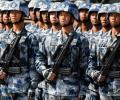
Asked about the continued tensions along the border and whether the PLA troops action was anyway related to the disagreements with the Indian government's plan to lure business out of China, Chinese Foreign Ministry spokesman Zhao Lijian said both the countries were in diplomatic contact over the face-off between their troops.
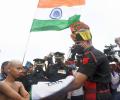
'This Chinese behaviour we have not seen for a very long time.' 'This sort of build up on the border, this pattern in Chinese behaviour, and especially the aggression and brutality with which our people were attacked on the 15th of June, this is not something we have seen before.'

The director general-level talks between border forces of India and Pakistan kicks off on Thursday days after parleys between their national security advisers were cancelled with the host nation set to flag the "most important" issue of ceasefire violations and cross-border infiltration.

The situation is now under control in the area, which is on the border between the Kolasib district of Mizoram and Cachar district of Assam.
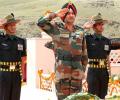
Lt General Ranbir Singh described the situation in Kashmir as stable but fragile.

"Our armed forces represent India's diversity and the collective spirit of 130 crore Indians. Our forces are not only known for their utmost professionalism but also they are at the forefront helping people in times of crisis. Our forces are synonymous with trust," Modi said.

'It is a pattern of behaviour of the Chinese that whenever a Chinese leader visits India or an Indian leader visits China, some incidents take place.' 'When Modi visits China, we should look out for some similar demonstration by the Chinese.'
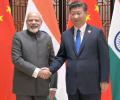
The Chinese and the Indian troops were engaged in a standoff for 73 days in Doklam.
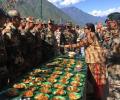
Sitharaman visited forward army posts in remote Anjaw district of Arunachal Pradesh bordering China on Sunday to take stock of the defence preparedness.

The MEA spokesperson further said the actions and behaviour of the Chinese side since earlier this year along the LAC have been in "clear violation" of the bilateral agreements and protocols concluded between the two countries to ensure peace and tranquility on the border.

The Ministry of External Affairs (MEA) spokesperson Anurag Srivastava said complete disengagement requires re-deployment of troops by each side towards their regular posts on their respective sides of the Line of Actual Control(LAC) and this can be done only through mutually agreed actions.
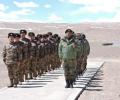
The sources said the ongoing engagement and dialogue at military and diplomatic levels have resulted in complete disengagement of troops at patrolling point 14, 15 and 17 A in eastern Ladakh.
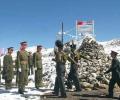
The Indian delegation led by Lt General Harinder Singh, the general officer commanding of Leh-based 14 Corps, and Commander of the Tibet Military District Maj Gen Liu Lin held an extensive meeting in Maldo on the Chinese side of the Line of Actual Control in eastern Ladakh on Saturday that began at around 11.30 am and went on till evening.

The formal process of disengagement of troops began on July 6, a day after a nearly two-hour telephonic conversation between National Security Advisor Ajit Doval and Chinese Foreign Minister Wang Yi on ways to bring down tensions in the area.

'A lack of strategic trust and the 'persistent security dilemma' prevails between India and China,' points out Dr Rup Narayan Das.
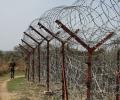
Introducing a new irritant into the bilateral ties, Pakistan has complained to UN Security Council alleging that India was building a wall along the International Border in violation of the world body's resolutions.
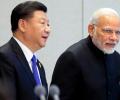
It is apparent that an easing of tensions at the border and a disengagement of troops is on the cards, observes Ambassador M K Bhadrakumar.

The travel advisory is perhaps a first of its kind issued by any state government

China has sharply reacted to India's plans to construct a road network along the McMohan line in Arunachal Pradesh and expressed hope that India will not take any action which may complicate the situation before a final settlement is reached to end the boundary dispute.

Answering questions on the clashes near Naku La Pass in the Sikkim sector which resulted in injuries to both sides, Chinese Foreign Ministry spokesman Zhao Lijian said that the most pressing issue for the world at present is the fight against the coronavirus.
India's envoy had said that stand-off in Doklam saying it happened because Beijing tried to alter the "status quo" which it should not have.
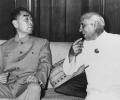
'Unquestionably, the spirit behind the Panchsheel agreement and the 'Hindi Chini bhai bhai' slogan were thrown overboard by the Chinese, and a trust deficit was injected between the two nations.' A revealing excerpt from General J J Singh's The McMahon Line: A Century Of Discord.

Prime Minister Manmohan Singh has said that commitment by Indian and Chinese leaderships to maintain peace and tranquillity at borders pending boundary settlement is an important guarantor for further progress in Sino-Indian ties, particularly growth of 2.5 billion people.
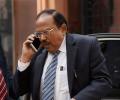
Besides the border question, India and China discussed issues related to counterterrorism including Beijing's blocking of India's bid in the United Nations to ban Pakistan-based JeM chief Masood Azhar, National Security Advisor Ajit Doval said on Thursday.

Tainted former Pakistan pacer Mohammad Asif says he wasn't the first nor would be the last to have indulged in spot-fixing and should have been treated better by the Pakistan Cricket Board, which gave "everyone a second chance" except for him. Asif was banned for seven years for his role in the 2010 spot-fixing scandal during Pakistan's tour of England, where he bowled deliberate no balls for money. He also served jail time in the UK after being found guilty along with Mohammad Amir and Salman Butt.
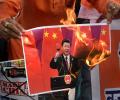
'And this mirror imaging is the most dangerous thing because it leads to tremendous misunderstandings.'

Just like China wants Trump to lose the US presidential poll, it may want Modi to lose the Lok Sabha polls. So months before the 2024 elections, China may take possession of an important area, say one of the Char Dhams, warns Sanjeev Nayyar.

Mr Warne, the world will miss you.
Chinese military has also deployed a sizeable number of its troops in Galwan Valley, the site of the violent clashes on June 15 that left 20 Indian soldiers dead.
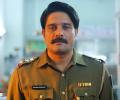
If Irrfan could have been our finest professor of empirical philosophy, and Nawaz is our foremost poet of that space halfway between the gutter and the stars, then Jaideep Ahlawat has to be our greatest artist-scientist, asserts Sreehari Nair.

Chances are any such disruption will not occur on the major shipping lanes but on some edge of the ocean between India and China. Even if there is no actual disruption, the costs of averting one can be punitive. The setting for this is provided by the energy shortage both countries face, says Subhomoy Bhattacharjee.

New Zealand captain Kane Williamson won applauds for his innovative captaincy during the recently held World T20 in India. The Kiwi star will now be donning a new role, that of a solid middle-order batsman for his Indian Premier League team Sunrisers Hyderabad. Williamson along with India's Virat Kohli, Aussie captain Steven Smith and Joe Root of England are considered to be most technically correct batsmen in the present era. Catch him in a chat with IPLT20.com.

The stand by China spelt out by its foreign ministry insisting that it takes the 1959 line on perception of the LAC amid a nearly five-month-long border standoff in eastern Ladakh triggered a strong reaction from India.
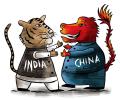
India and China achieved a major milestone this year when their bilateral trade crossed the landmark figure of $100 billion but it did not generate any fanfare in both capitals as the two Asian giants are going through a "particularly bad patch" in their relations due to a set of actions by Beijing in violation of agreements that led to the military standoff in eastern Ladakh. Starting with a modest $1.83 billion in 2001, the bilateral trade crossed $100 billion-mark in the first 11 months this year, a significant milestone for which the two countries carried out campaigns to boost trade and build it as a major stakeholder to improve the relations between two nations, whose ties otherwise remained frosty over the festering boundary dispute and strategic rivalry. According to last month's data from China's General Administration of Customs (GAC), the India-China bilateral trade totalled $114.263 billion, up 46.4 per cent year-on-year from January to November 2021.

A simultaneous announcement about the meeting was made from New Delhi and Islamabad on Wednesday after Foreign Secretary Sujatha Singh and her Pakistani counterpart Aizaz Ahmad Chaudhry had a telephonic conversation.
 © 2026 Rediff.com - Advertise with us - Disclaimer - Privacy Policy - Sitemap - Feedback - About us - Terms of use - Grievances